Austria’s foreign trade came under considerable pressure in 2025. Exports of goods fell by 1.1 percent in real terms, whilst imports rose by 4.8 percent. As a result, the trade balance deteriorated significantly, recording a deficit of 6.6 billion € or approximately 1.3% relative to nominal gross domestic product. Although the FIW expects a moderate recovery in exports for 2026 and 2027, the risks arising from geopolitical tensions, rising energy prices and trade policy uncertainties remain high.
The “Research Centre International Economics” (FIW) published its seventh annual report on the “State of Austrian Foreign Trade” on Wednesday, 19 May 2026. The report analyses the international framework conditions and contains a short-term forecast of Austrian foreign trade developments for the years 2026 and 2027. For the first time, the study also examines in detail monetary foreign trade relations and medium-term changes in the global trading system.
This year’s analysis focuses on the economic consequences of geopolitical tensions – in particular the US’s protectionist trade policy, the conflict in the Middle East and the resulting energy price shock.
Exports down, imports up significantly
Austrian goods exports performed weakly in 2025, falling by 0.5 percent in nominal terms. The main factors were weak demand from key markets such as Germany and the rest of the euro area, particularly for capital goods, as well as increasing geopolitical and trade policy uncertainties. In addition, intensified international competition, including from China, weighed on export performance. Although the first signs of stabilisation emerged towards the end of the year, these were not sufficient to offset the decline for the year as a whole.
Imports of goods, by contrast, performed much more strongly, rising by 4.8 percent in real terms. The main drivers of growth were the recovery of equipment investment and domestic demand for durable consumer goods, in particular car imports as well as pharmaceutical products and precious metals. Imports from Switzerland and China recorded particularly strong growth.
As a result of the divergent trends in exports and imports, the trade balance in goods deteriorated significantly. The trade deficit amounted to 6.6 billion € in 2025. Negative volume effects could only be partially offset by favourable terms-of-trade effects.
Subdued outlook for 2026 and 2027
For the years 2026 and 2027, the FIW forecasts only a gradual recovery in Austria’s foreign trade. In the baseline scenario, exports (goods and services) are expected to grow by 1.5 percent in 2026 and 2.2 percent in 2027. Imports will also increase only moderately, by 1.0 percent in 2026 and 2.0 percent in 2027.
However, the forecast is subject to a high degree of uncertainty. Key risk factors remain the economic consequences of the war in Iran, rising prices for fossil energy sources, disruptions to global supply chains, and increasing uncertainty regarding investment and consumption decisions.
Against this backdrop, the report distinguishes between a main scenario and a pessimistic alternative scenario. The central assumption concerns the development of prices for crude oil and natural gas. This depends largely on the extent to which the global energy supply is disrupted by restrictions in the Strait of Hormuz or by destroyed production capacities in the Middle East
In the main scenario, the FIW assumes a crude oil price of 88 $ per barrel (Brent) in 2026 and 76 $ in 2027. Natural gas prices are expected to be 49 € per MWh in 2026 and 37 € in 2027. In the pessimistic scenario, by contrast, a significantly sharper and more prolonged rise in energy prices is assumed. In this case, the crude oil price would rise to 106 $ per barrel in 2026 and stand at 80 $ in 2027. Natural gas prices would rise to 64 € per MWh in 2026 and 58 € in 2027.
The impact of the pessimistic scenario on the external economy is considerable: growth in real exports would amount to just 0.3 percent in 2026 and only 1.1 percent in 2027. Imports could even decline slightly in 2026 before rising moderately again in 2027. At the same time, the trade balance would deteriorate significantly more under the pressure of higher energy prices.
Weaker international environment
The international environment also remains challenging. The global economy grew by 3.4 percent in real terms in 2025, but a slight slowdown to 3.1 percent and 3.2 percent is expected for 2026 and 2027 respectively. Whilst the US economy is growing at a comparatively dynamic pace, the European Union and, in particular, Germany – Austria’s most important export markets – are lagging significantly behind. Global trade is also expected to slow following a strong rise in 2025.
Focus on monetary policy and structural changes
For the first time, the Annual Report also provides a detailed analysis of monetary external economic relations. The focus is on inflation trends, monetary policy strategies and exchange rate dynamics in the major economies.
The monetary policy landscape in 2025 was characterised by falling inflation, moderate economic growth and persistent geo-economic uncertainties. With the energy price shock following the war in Iran, monetary policy once again came into sharper focus at the start of 2026.
For Austria, the real effective exchange rate based on unit labour costs shows a smaller appreciation than the euro area average. This points to a slight improvement in price competitiveness, though this is put into perspective by the strong inflation-driven appreciation in previous years.
Furthermore, the report examines medium-term changes in the global trading system. The focus is on rising trade policy uncertainty, increasing protectionist measures and the structural consequences of geopolitical conflicts for the international division of labour.
These developments are driving a reorganisation of global supply chains in the sense of “friendshoring” and reinforcing the formation of blocs in world trade. For the European Union, this increasingly raises the question of how economic openness, security of supply and strategic resilience can be better reconciled in the future.
Diversification and resilience are gaining in importance
Current developments underscore the importance of an active risk-reduction strategy at European and national level. The focus is on diversifying supply and sales markets, deepening trade relations with rule-based partners, expanding renewable energy, and building more resilient international supply chains.
The recent energy price shocks and the increasing fragmentation of world trade demonstrate how important it is to reduce structural dependencies at an early stage. In addition, the FIW recommends a broad-based industrial strategy to specifically reduce critical dependencies on raw materials, energy and digital technologies, whilst simultaneously strengthening Europe’s long-term competitiveness.
The FIW Research Centre Internatioanl Economics, is offering a grant for outstanding young female researchers in the field of international economics.
The “FIW award” is aimed at qualified female researchers up to the age of 35 who have completed a doctoral thesis in the field of international economics at an Austrian university, or at Austrian citizens who have completed their doctoral thesis at a university abroad. The FIW Award aims to highlight and reward outstanding research by women.
The aim of the FIW Award is to highlight and reward outstanding research by women with the intention to encourage women to pursue a scientific career.
The total amount of the award is € 3,000 and can be divided among several young researchers. The actual distribution of the prize money will depend on the quality and number of submissions.
Theoretical, empirical and economic policy theses on the following topics are eligible for funding:
Foreign trade, direct investment, development economics, European integration, geoeconomics, globalisation, international financial markets, international trade and financial institutions, international macroeconomics, international economic development, international trade, international competition, multinational companies, environmental impact of international economic activities, economic effects of migration, exchange rate regimes, and similar topics.
The following criteria are decisive for the evaluation of submissions:
The thesis must have been completed between 1 October 2023 and 19 December 2025.
The submission must include the thesis in PDF format and a CV.
Inhaltliche Kriterien:
Scientific quality: 40%;
Klarheit der Argumente und Resultate: 20% ;
Innovation and creativity: 20%;
Policy relevance: 20%.
Please send submissions to: FIW Project Office fiw-pb@fiw.at
Organisers: Pol Antràs (Harvard), Alejandro Cuñat (University of Vienna), Harald Fadinger (University of Vienna) and Kalina Manova (UCL) Keynote Speakers: Matilde Bombardini (Berkeley) and Thierry Mayer (Sciences Po)
We invite submission for the 9th edition of WIEN, a two-day meeting that will draw together researchers interested in international economics, global value chains and economic geography.
The workshop will take place in the University of Vienna’s beautiful Sky Lounge with a view over the city. To be considered for inclusion on the programme, papers must be submitted in PDF format to Mrs. Mieke Hein (hein@wiiw.ac.at) by Sunday, March 15, 2026. Authors chosen to present papers at the conference will be notified in early April. The organisers are particularly keen on receiving submissions from young scholars, including Ph.D. students and researchers who have just completed their Ph.Ds. With that in mind, we would appreciate it if you could circulate this Call for Papers among your junior colleagues, former students and current Ph.D. students. As in past editions, we will actively seek diversity in the set of selected speakers. Participants will be provided with accommodation in central Vienna, and airfares for speakers based at academic institutions will also be reimbursed subject to certain budget guidelines. The conference is generously supported by the Heinrich Graf Hardegg’sche Stiftung, FIW, University of Vienna, wiiw, and the 1 UKRI under funding agreement with the ERC.
FIW is proud to part of a new seminar series in Vienna. The VIES seminar is dedicated to frontier research in international economics and features presentations by renowned international scholars.
The VIES is a joint initiative of CEU, FIW, Universität Wien, WIFO, wiiw and WU.
The seminar is held on Tuesdays from 17:45 to 19:15 at irregular intervals, alternating each semester between participating institutions. From October 2025 to January 2026, it will be hosted by the University of Vienna at the Faculty of Business, Economics and Statistics, Oskar-Morgenstern-Platz 1, 1090 Vienna.
From April 2024, the BMAW will publish up-to-date, high-quality estimates for nominal, real and seasonally adjusted foreign trade in goods data on the FIW website on a monthly basis using an econometric model developed by the Institute for Advanced Studies (IHS). This means that current forecasts (so-called nowcasts) of Austria’s monthly foreign trade are available – with a lead of more than two months compared to the publications of Statistics Austria. In addition to the nominal values, the FIW Trade Indicator also shows price-adjusted real values. This real foreign trade data gives an exact impression of the actual increase in Austria’s welfare due to foreign trade and is also seasonally and working day adjusted. As a result, the nowcasts differ from the unadjusted, nominal values published by Statistics Austria. For example, unlike last year, the Easter holidays fell in March this year. In the official unadjusted time series, this results in an apparent decline in the growth rates of foreign trade in goods in March and an apparent increase in April. This distortion is avoided in the FIW Trade Indicator.
“We need up-to-date data in order to gain an accurate understanding of the growth rates of our foreign trade in goods to be able to promptly assess Austria’s increase in prosperity and the economic trends in foreign trade,” explained Minister of Labour and Economy Martin Kocher.
The Federal Ministry of Labor and Economy (BMAW) has therefore commissioned the Institute for Advanced Studies (IHS) to create a nowcast of Austrian foreign trade in goods using econometric methods and up-to-date data.
Starting in April 2024, the BMAW will publish up-to-date, high-quality estimates for Austrian trade in goods in the previous month on a monthly basis. In addition to the nominal values, the FIW Trade Indicator also shows price- and seasonally adjusted values, which eliminate distortions caused by seasonal influences and public holidays in order to allow a timely assessment of economic trends in foreign trade. This means that, for the first time, timely and reliable forecasts of Austrian foreign trade are available. For comparison: Statistics Austria publishes the first provisional data on nominal exports and imports of goods with a time lag of more than two months.
The FIW Trade Indicator is now available on the FIW website under the section ‘Data’.
The Department V/7 “Trade and Competition Policy Analysis and Strategies” of the Federal Ministry of Labour and Economic Affairs invites proposals for a study:
Study topic: Analysis of the effects of the EU trade agreements with Australia and New Zealand.
The Department V/7 “Trade and Competition Policy Analysis and Strategies” of the Federal Ministry of Labor and Economy invites to submit proposals for a study:
Topic of the study: Meta-study on Europe’s and Austria’s trade dependence on China
After strong growth years, Austria’s foreign trade stagnates in 2023
After a dynamic development in 2022, the “Forschungsschwerpunkt Internationale Wirtschaft” (FIW) expects a low growth of Austrian exports and imports in 2023.
https://youtu.be/Aijw4S7luRU
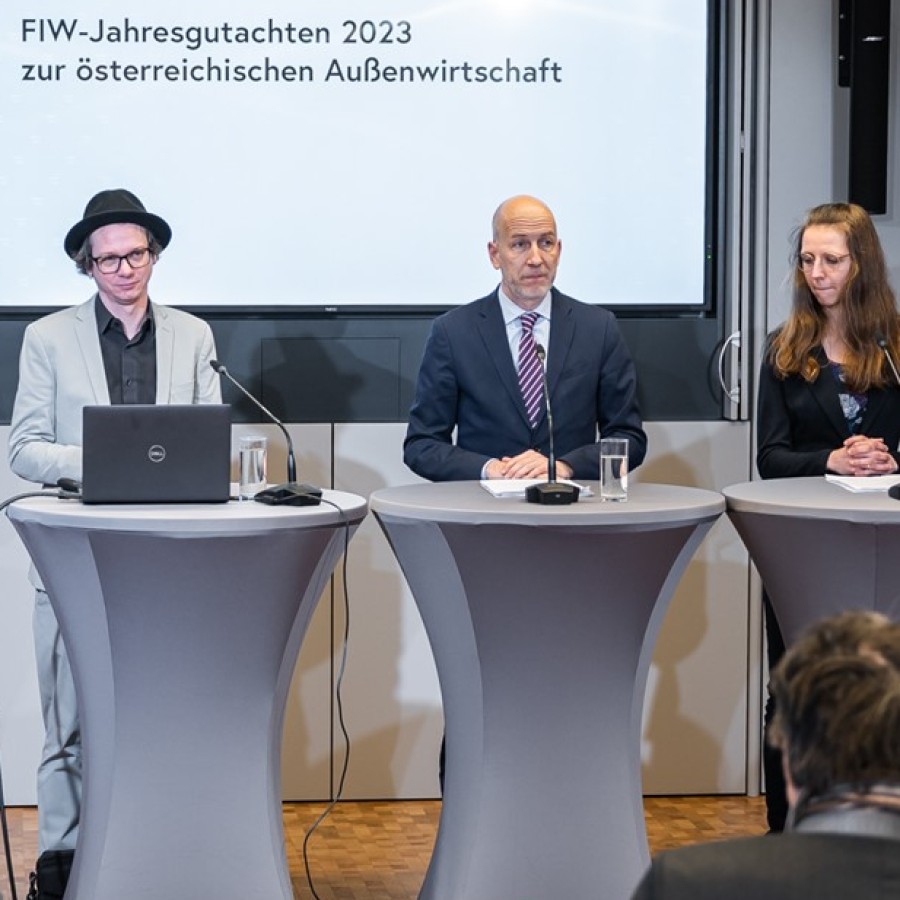
FIW’s fourth annual report on the “Situation of Austria’s Foreign Trade” was presented together with Labor and Economics Minister Martin Kocher. The annual report is dedicated to the current international framework conditions for Austria’s foreign trade and trade developments in 2022. In addition, study authors Harald Oberhofer (WIFO, WU Vienna) and Robert Stehrer (wiiw) as well as study author Bettina Meinhart (WIFO) presented short- and medium-term forecasts for the expected future development of Austria’s foreign trade relations.
The year 2022 was dominated by the Russian attack on Ukraine and the subsequent energy price crisis. Households and companies were massively affected by the rise in energy costs. From the 2nd half of the year, the resulting supply shock and high inflation rates left their mark on the global economy. Austria’s dependence on Russian natural gas posed particular challenges for domestic households, companies and politicians. Austrian foreign trade held up relatively well under these difficult conditions, but suffered from the significant deterioration in terms of trade, i.e. a worsening of the relationship between export and import prices, in 2022. Prices for Austrian goods exports increased by 5.5 percentage points less than import prices. In pure volume terms, Austrian exports have developed more dynamically than imports: According to the forecast, total exports of goods and services rose by 8.8% in real terms in 2022, while imports increased by 5.1%.
In 2022, the negative terms-of-trade effect outweighed the quantity effect, so that in 2022 Austria’s trade balance deteriorated by €7.6 billion compared with 2021 and showed a deficit of €-20.5 billion. The more positive development of the services balance, which was driven by a massive increase in travel exports (more trips to Austria by foreign tourists), was able to offset the trade deficit last year. In 2022, the current account balance will be in positive territory at € 200 million.
For 2023, the “Research Centre International Economics” (FIW) forecasts growth in total exports of 0.3%. Imports are expected to rise by 0.9% this year. Mainly due to rising import prices – caused by the energy crisis – Austria could show a negative current account balance in 2023 for the first time since 2001. According to the forecast, the deficit will amount to € -1.8 billion (0.4% of GDP).
In 2023, the deterioration in terms of trade based on the study forecast continues with a decline of 1%. Exports of goods are expected to increase by 0.1%, with services exports recording growth of 1.2%. Total imports will grow by 0.9%. The difference between exports and imports results from higher services import growth of 3.3%. The trade balance could deteriorate to -€23.3 billion due to the further negative terms-of-trade effect. This deficit will no longer be fully compensated by the services balance surpluses. In 2023, the Austrian current account will show a negative balance with a deficit of €-1.8 billion (0.4% of GDP). According to the forecast, the current account should return to a small surplus in 2024.